

Exploring the decision making about hearing interventions of parents of children with Microtia and single sided deafness: a qualitative study
In 2018, Microtia UK awarded Audiology researchers from Aston University a research grant to continue their research on parental decision making for children with single sided deafness (SSD), focusing on families of children with Microtia.
What did we investigate?
Single sided deafness is common in children with microtia. The UK care standard for patients with microtia states that bone conduction hearing aids should be offered to all infants and children with SSD, however there is limited evidence on their effectiveness for SSD in children, and when and how best to fit. Access to bone conduction hearing devices also varies across Audiology departments so there is variability in what is offered to parents. There is also variability in the uptake of devices by parents, but it is not known what influences decision making. We aimed to find out how parents make decisions about their child’s SSD.
What did we do?
We carried out a qualitative study to investigate parents’ decision making processes. A qualitative study aims to understand how and why things happen, and examines in-depth what people say about a topic to identify common themes and meanings.
We interviewed 20 parents of 21 children with SSD, 11 of whom had microtia and 10 without microtia. The children ranged in ages from 4 months to 16 years old. We asked parents to talk in their own words about their child’s SSD and their decision making.
The interviews were analysed to identify key themes in what parents said about their child’s SSD and the process of decision making.
What did we find?
- Families want their children to be involved in decision making about their SSD and to have autonomy (or choice), such as in deciding whether to have a hearing aid or have ear reconstruction.
- Decision making is ongoing throughout a child’s life. Families are often conflicted about what is the right thing to do for their child and constantly re-evaluate and question their actions and decisions. There is often a balance to be struck between preserving their child’s autonomy and judging the right course of action at a particular time.
- A factor influencing decision making was whether parents perceived their child was “deaf enough”. If they felt their child’s SSD was impacting on their life, such as their speech development, then this influenced decisions to access hearing devices.
- Parents seek information and support for decision making from a range of sources. The Microtia Network is well regarded, valued and needed by its members. All participants reported engagement with the Microtia Facebook page to varying degrees as well as the Microtia UK webpage resources. Some families attended the Mingles and travelled extensively for these, whereas others appreciate this opportunity but do not feel they need to attend. Groups such as Microtia UK are valuable in providing families with information and support.
- Parents’ interactions with audiology were not always helpful, and services did not always offer information and support. Parents reported good support from their teacher of the deaf.
- All participants experienced levels of emotional distress regarding their initial encounter with healthcare professionals in the diagnosis of microtia. This included how information was given about the physical appearance of the ear as well as miscommunications regarding the implications of hearing loss.
- Parents wanted to provide their child with a sense of autonomy around reconstructive surgery in addition to their hearing needs. One family in this study had been through the reconstructive process and others had had discussions with their child as they got older. Parents wanted to involve their child but felt they needed more information to help their child with making their own decisions.
How are we sharing our results?
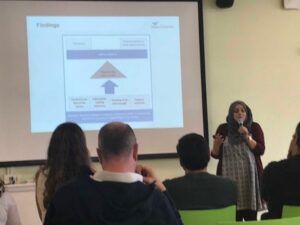
We have presented our findings to Microtia UK at the recent family day in June. We also plan to present our results to Audiologists and Teachers of the Deaf at several national conferences. We will publish our findings in an academic journal and through the Microtia UK website.
What next?
Our findings show that parents need better support and information from clinical services both at the diagnosis stage and ongoing as their children move through different stages of life. There is also the need to support children and young people with making their own decisions.
We would like to continue working with the Microtia community to lead to changes to clinical practice to better support families and people with microtia.
Parents respected their child’s wish for autonomy and this is an area for further research. This would explore the views held by children and young adults who hold more responsibility for their hearing needs and surgical decisions as they grow older and explore how these form part of their identity as they progress through different stages of life.
The research team
Saira Hussain, Dr Helen Pryce, Amy Neary and Dr Amanda Hall
Audiology, Aston University, Birmingham
For further information about the study, contact Saira: s.hussain14@aston.ac.uk
The full research paper can be found here.
20.06.2019