Gillian's Story
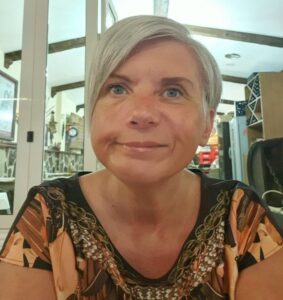
I was born in 1974 with the majority of the clinical features featured above, except cleft. When I was finally diagnosed in 1980, at the age of six, with Hemifacial Microsomia (HFM), Microtia, Atresia, and Anotia, my family faced a daunting journey into the unknown.
Early intervention allowed the NHS team looking after me to develop a tailored treatment plan that evolved alongside my growth. Thanks to the dedication and expertise of the craniofacial team at NHS Greater Glasgow, led by Professor Ian Jackson and later Professor KF Moos, my story became one of hope, resilience, and transformation. I am eternally grateful!
Surgical Innovation and Collaborative Care
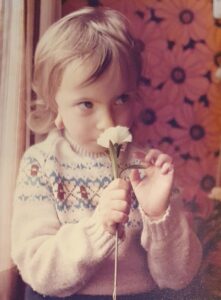
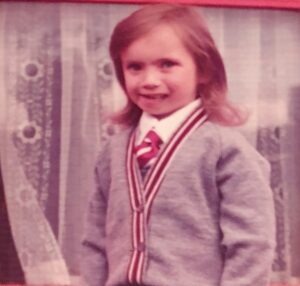
My childhood involved multiple hospital visits and surgeries, with my reconstructive pathway including:
Mandibular Distraction Osteogenesis: Gradually lengthening the underdeveloped jawbone and taking bone from other parts of my body strengthen the jaw.
- Auricular Reconstruction: At a young age, constructing an ear on right side using my own tissue, which unfortunately failed.
- Maxillomandibular fixation (MMF): I underwent this procedure of jaw wiring twice through mandibular procedures.
- Soft Tissue Augmentation: Refining facial contour and balance through various surgical procedures. I underwent tissue expansion where a balloon was fixed in place and saline was inserted to stretch the tissue on my cheeks, and once satisfactory, enabled the surgeons to take skin graft from my thigh and position in my right cheek.
- Prosthetic Ear Fitting: Managed by the Prosthetics Team.
Once I stopped growing, at the age of 16, I attended appointments at the Prosthetic department at Canniesburn Hospital for the constructing of a prosthetic ear. Each phase was carefully timed with developmental milestones, minimising disruption to my life and maximising benefit.
“Early intervention and teamwork changed my life.”
Although I was young, my parents were consulted each step of my journey and even though they didn’t know anything about the condition themselves, they were confident that the Maxillofacial Team would do the best of their ability.
Unsure of how it is these days for patients, I think the only thing that was missing for me back then was the psychological aspect of not having anyone that had the same condition as me that I could talk to. I had the doctors and the nurses on the ward, but it wasn’t the same and often felt isolated throughout my childhood as I was visibly seen as “different” or “not normal” and stared at quite a lot.
Even as an adult, it still stirs up memories of particular procedures, heart stopping on two separate occasions during surgeries, and my rehabilitation journey, but I choose to think that I am here for a reason and with that purpose, live life to the full. Now, people don’t stare and I actually choose not to wear my prosthetic ear anymore. I think as I got older, I felt less the need of ‘having to fit in to look the same as everyone else’.
I have a, now, 11-year-old son, but when I fell pregnant, I remember having that awful daunting feeling of wondering if my baby would have the same condition. With early intervention of testing, there were no appearances from scans that would indicate they would have. My feelings were only of thinking that I was very apprehensive of not wanting my child to go through what I went through.
With all in mind, I would be very interested in starting a Microtia/HFM Peer Group in NHS Forth Valley for all patients and parents affected. I am a member of a HFM Facebook group, but it’s based in America and although it’s beneficial to see how the wonders of modern medical technology has evolved, I feel that it would be advantageous for patients alike to share their experiences and challenges and also for parents to talk about their fears going through this journey.
What this means for me at work?
Finally, in a light-hearted way, there are a few things, with a little help from colleagues, that are most beneficial in the day-to-day running for me at work:
- Don’t stand on the right side of me as I can’t hear a thing and sound doesn’t travel that quick for me to relay a quick answer to you or engage in any sort of conversation.
- Any background noise i.e radio, traffic, or even more than one person speaking at one time – my brain and with the one ear I have, can’t possibly comprehend or take anything in that’s being said.
- If you turn your back on me and proceed with a conversation, I can’t hear a word you’re saying.
- If I’m on the phone, please don’t speak to me. I’m not being ignorant, I just can’t hear you if the phone is pinned to my hearing ear.
- When entering a face-to-face meeting, I scan the room to work out the best place to sit and position myself so that I can hear.